Monday, December 10, 2012

Floor plans, Balderdash, and What's it REALLY about?


You’re Invited!
Let’s gather in the classroom at 2:20 on Friday (12/14) to hear the students recite the poetry they’ve been working with for a couple weeks now.  Let me know if you can make it!
-Devin

Writing in Response to Reading: What is this story REALLY about?
Today in Writers' Workshop I told the students that I’d be sharing some stories about riding a Ferris Wheel. I walked them through four story ideas, each taking place on a Ferris Wheel, but with very different messages. One was about conquering a great fear, one about connecting with a father, one was about wanting to cling to the joys of earlier childhood, and one was about enjoying peaceful moments alone. We saw how it wasn’t enough to say, “The story is about a Ferris Wheel ride.” We needed to ask, “What is this story really about? What is the significance the author wanted to highlight?” Then, we noticed the craft choices the author made and thought, “How does the author’s decision to title the story like this, to start at this point or elaborate this section, convey a meaning that resonates? How can we find evidence of the author’s purpose in the choices he or she made as a writer?”
After the lesson, the writers got to work investigating the real significance of Dear Mr. Henshaw, Freedom Summer by Deborah Wiles (a BEAUTIFUL picture book about civil rights in the '60s), or their independent reading book. Here are some samples. I've highlighted the students' use of the sentence starters I've taught them to help push their thinking. 
************
I think Spiderwick is really about how it doesn't matter what other people believe in, it matters what YOU believe in. The reason I think this is that it is about faeries and sprites and trolls and the people in the book talk about how they believe in magic, but about 55% of the people in the world do not believe in magic. It is good to believe whatever you want because you are free. 
************
What general ideas about life and relationships are wrapped up in this story? Sometimes you won;t realize how special something is until it is gone. Abby Lovitt learns when one of her horses Jewel (the one that she calls Pearl) dies. Since she learned that Pearl felt special to her. 
************
I think this story is really about how powerful connections can be between people like between Lily and her grandma and how she misses her dad because he is going to war. The thought I have about this is Lily's grandma doesn't really like Jewish people. She doesn't hate them, but she is uncomfortable. The reason I had this thought is Albert might be Jewish and that's why Grandma doesn't like Lily hanging out with him (it says he has a secret sewn into his coat). I think he escaped from World War II to save his life. Another thought I have is Lily might be depressed because of all the war going on. Maybe Lily thinks that it is going to now be a good summer because they are in Rockaway. 
************
The book showed two boys with different skin color playing through the book. John Henry is more mad than sad that the pool was closing because of the new rule. He has angry tears. 
************
This story tells you don't be greedy, it just makes a problem. I found this out because Set wanted to be king, but then he's going to destroy the world. 
************

Alex and Gloria share their work as writing partners for this unit:


Math
For the last couple of weeks, all of the students have been in a geometry unit centered on quadrilaterals, so we've been able to work together as a whole class on some projects. Here you'll see students playing a game designed to reinforce skills for finding the area of a rectangle using multiplication for 4th graders and counting the interior squares on a grid for 3rd graders. Thus, the third graders have some useful background to bring to their multiplication studies that will begin first thing after the Winter Break. 


For the next two weeks until the break, 3rd graders will work with rounding, estimation, and money.
4th graders will continue to solidify their understanding of area and perimeter of rectangles before moving on to work with more complex shapes. They will design a tree house floor plan, find areas of rectangular and non-rectangular rooms and multiply their square footage by the price per square foot of their chosen flooring material. The third graders will participate in this project as well, with individually differentiated directions that most likely focus on finding perimeters of complex shapes and adding and estimating large sums. 

Class Democracy and Leadership
Skyler rocked it out as ambassador last week! He greeted a prospective family tour and remembered to check in with me after they left to tell me their eye colors (and thus prove that he made that all-important eye contact!). He facilitated a meeting in which we decided on a system for students to receive extra homework should they so desire. The kids can select a math challenge sheet and a creative writing prompt from the second drawer in the math station. Skyler received fantastic feedback from his peers after the meeting and I have to say, the feedback becomes more gracious, specific, and perceptive every week. I also notice that the students participate much more actively and thoughtfully in the meeting discussions after acting as facilitator. Isn't it a powerful perspective to try on a leadership role, and then step back? The kids are clearly more respectful and engaged in meetings after taking on the challenge of being ambassador. Way to go, Sky!


Alphabetizing and Dictionary Skills
We had tons of fun working with our dictionary skills and then playing a round of Fictionary (Balderdash).
Listen to these hilarious made-up definitions:
posthumous- noun. a very poisonous mushroom found in Australia. Known for its bright orange color
posthumous- noun. a scientific word for email
Yucatan- nnoun. a type of Native American hut
zoophyte- adj. disgusting, gross, odd, different in a bad way
status quo- noun. Jupiter's name before it was declared a planet
And my personal favorite:
status quo- verb. when you update your status with a quote
:)


Let me know if there's anything you've been wondering about life in our classroom that would be a good topic for my next post! 

Thursday, November 29, 2012

Teamwork, Pioneers, and "There, Their, They're"

We've wrapped up our novel study of Dear Mr. Henshaw. Here, Alex and Vivi are sharing what they know about the story and the writing by doing a book review. Alex is writing about the author's message and how she conveyed that message to the reader. Viv is referring to the text for specific examples of the character traits she highlighted about Leigh Botts. She references the exact page where she found her evidence. 


We're now reading Patty Reed's Doll by Rachel K. Laurgaard as a class. It tells the story of the Donner Party's treacherous and fascinating journey west to California from Springfield, Illinois. I like to teach with this book because it offers a narrative example of so many of the elements of Westward Expansion and pioneering that we're studying in Social Studies. As we learn about Lewis and Clark, we're also reading Who Was Sacagawea? by Judith and Dennis Fradin. It offers a look at the Corps of Discovery's incredible expedition through the lens of the Native Americans who already knew and lived on the lands being "discovered" by the American pioneers.

We've been working hard with those tricksters; there, their and they're this week. Here Mila searches the room for a sentence that needs her word, "there".


Teamwork!

Sami shares the proper use of they're:
If six copycats sat on a fence and one jumped off, how many would be left on the fence?
None, they're all copycats!

Here we see local ballet teacher, Charles sharing a little about his work and passion for dance. We learned about what to expect tomorrow at the Nutcracker and talked about the physical and mental strength and agility it takes to be a dancer.

Charles and his accomplished student, Sami demonstrate a dancer's posture.

Math time! Alex and Skyler work with the characteristics of congruent and similar shapes.

On most Wednesdays, we do a multi-step math challenge that requires some serious teamwork to complete.
This Wednesday's problem:
Grandma lives in Media, and her grandchildren all live within 40 miles. Scott lives 20 miles north of Brian. Robin lives 5 miles south of Scott. Grandma lives 10 miles north of Robin. Caitlin lives 15 miles south of Brian. How far does each live from Grandma?
It was great to see the students planning ahead, using logical reasoning, and utilizing some of their cartography skills from Social Studies. 


 Come by the classroom to check out our finished dioramas! These tiny worlds hold some pretty grand ideas. They're up on the bulletin board next to the poetry they inspired. Here's a sneak peek:


Peyton and Syler are sharing their dioramas and poetry with the class. It was cool to see these tiny, delicate scenes that we've been working with so intimately, projected on a large scale!


Karen came back this morning to work on Phase II of our lunchbox alarms! The students decorated the boxes with Julie in art. We found that the intricate engineering work took a lot of thoughtful precision, patience, and adjustment. We'll finish them in two more sessions next week.


Alex devours Wolf Brother.

Way to go, Max! This week's ambassador welcomed a touring visitor to the class and shared the work in progress with her. He also led a class meeting and decided to use an opinion polling technique in which the students stood up and placed themselves somewhere on the spectrum between two locations which represented a desire to name a class symbol for a flag or a class color. This way he could visualize the spectrum of opinions and go from there. Nice work!


Friday, November 16, 2012

Circuits, Microscopes, Essays, and Word Problems

Here's a mini-overview of the goings-on in 3rd and 4th grade math and humanities!

Reading and Writing
We just began our work with literary essays by reading short stories and writing entries responding to the reading. I teach some of the ways a literary essayist might study a text before writing about it. The students are observing the text closely and then pushing themselves to have thoughts about what they notice. A good literary essayist must first be a good reader, dreaming the world of the story, walking in the shoes of the character. After reading the story with empathy and imagination, the essayist shifts to reread the text with an analytical critic's eye, constructing a logical argument about what he or she sees. 

Math
Both third and fourth graders will be working with word problems until the Thanksgiving break. They are de-coding story problems with extra, unnecessary information, searching for the clues they need to find the answer. Third graders are working with addition and subtraction problems featuring a total and two partners (addends and subtrahends). If one of the partners is unknown, it can be found by subtracting the known partner from the total or by counting on from the known partner to the total. They're also working with problems that involve one amount that is more or less than another amount and using comparison tools to find the difference. 
Fourth graders are working on multi-step word problems such as, "Eli is ordering 5 pizzas for a party. Each pizza will be cut into 8 slices. Three pizzas will have multiple toppings and the others will be plain cheese. How many slices of plain cheese pizza is Eli ordering for the party?" These problems require significant analysis and organization. I teach different mental and written organization techniques and processes to divide up the necessary information into steps. 

Can't wait to see you all tonight at the San Rafael Community Center!

Viv and Max welcome their ancestors back during our class Dia de los Muertos celebration. 


Halloween was pretty much the most fun EVER!  :)


We were so inspired when Lisa shared her dioramas, we had to have a go at it ourselves.


Sami keeps us focused and engaged as she leads a discussion about whether or not students should be allowed to draw during read-aloud time. The class decided that it would be too distracting and that we'd re-visit the idea again later. Amazing job, Sami!


Sweetness.

Hugo brought in his microscope to share with his scientific community. I sent him next door to share with the 1st and 2nd graders. Lindsay said that he really inspired her Junior Scientists. Our class was also really excited to see his slides and guess what they were. We thought the slide of a drop of blood was really cool!


A CCS-inspired art project that Lisa and Caroline are coordinating for the auction


Vivienne facilitated a productive class meeting in which a student proposed that we go on a 3rd and 4th grade class overnight field trip. The class voted and came to the consensus that such a trip would be a great way to build our team. A future facilitator will have to continue to work with the group to fill in the details in a way that works for everyone, including your's truly. :)  Awesome job synthesizing some very diverse opinions, Vivi!


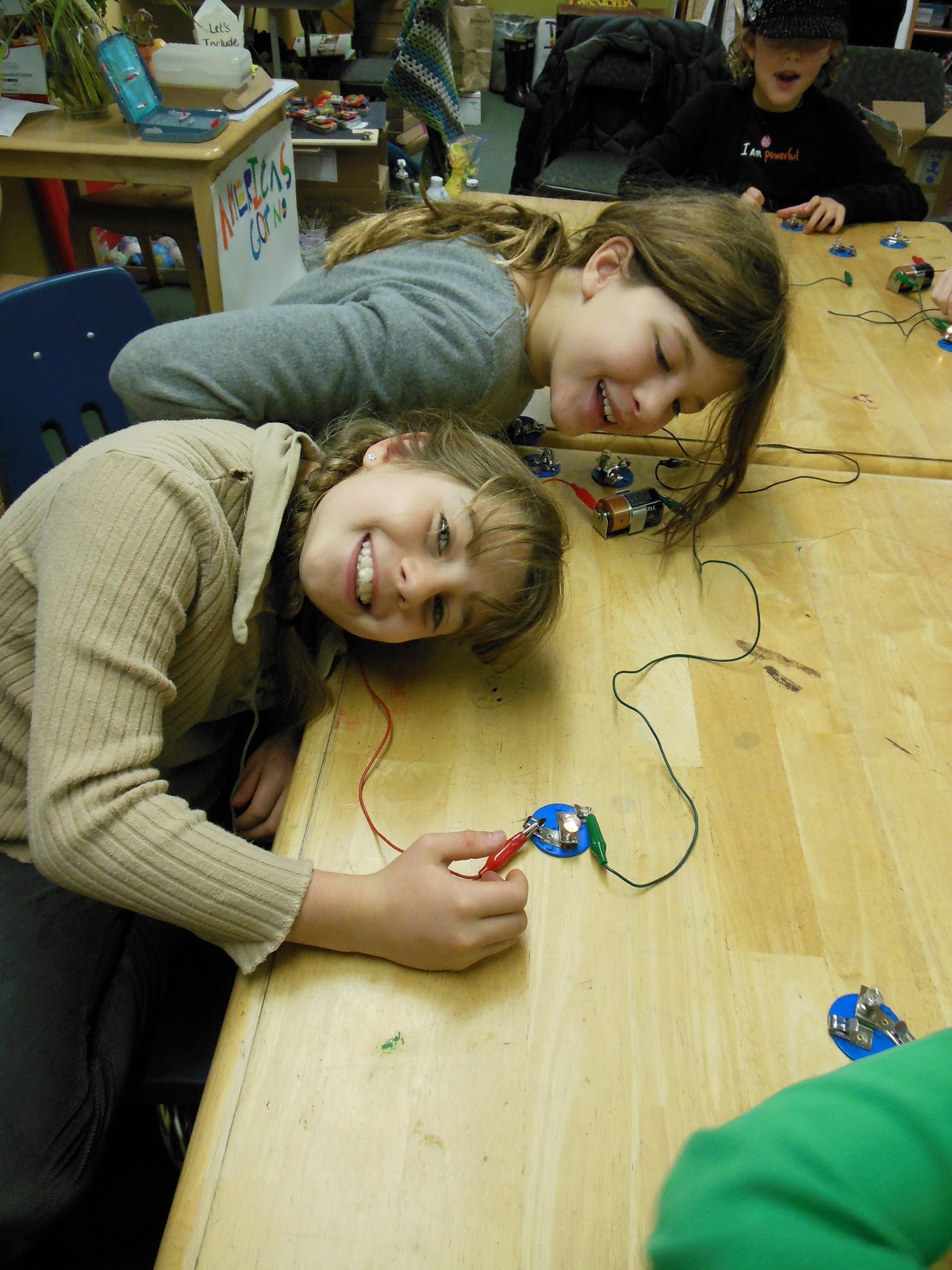
Karen joined us this morning to teach us about electricity and circuits! So cool! We'll use our new knowledge of batteries and closed circuits to build lunchbox alarms next week.


dfah